
Capitalism & Schizophrenia Part IV: The Schizoanalytic of the Post-Modern Body Politic
Problematizing the post-capitalist reterritorialization of the body politic; a clash of civilization-defining narratives, and the resolution of the bipolar schizoid analysis.

In the aftermath of the Second World War, the world entered into a distinctly post-modern phase. The Great Narratives of modernism: progress, materialism, scientific endeavor, and so forth had proven ultimately to be nothing more than excuses for the exercise of domination and power, the need for ever-expanding territories, and for exploitative colonization of militaristically-poor but resource rich nations by global superpowers. Marxism, the last great ideology of modernism, had promised us a post-capitalist utopia, except that the nations that were supposed to grow beyond capitalism retreated to it to rebuild after a war that saw us develop the power to literally destroy ourselves.

In the atomic age, Marxism would be represented by a repressive totalitarian, isolationist empire, set in an existential battle against an expansive capitalist regime bound and determined to convert all human flourishing to grist for its economic mill.
And the decades of the 1950s and 60s did precious little to disabuse that notion. In particular, the global left, or at least the non-Marxist-Leninist or Maoist left, had to attempt to develop a new politics. The emergence of the New Left saw the sublimation of class politics for identity politics, particularly feminism, anti-racism, post-colonialism, and anti-Eurocentrism in academics and politics. The emerging post-Marxist analysis was of how people interacted with the world, not merely in terms of economic production but as human beings.
This also led to the philosophy of mass media attempting to understand a world in which images and sounds could be beamed anywhere near-instantaneously, where news spread at the speed of light and no fact was beyond us. This led us to doubt the very metanarratives we had been fed as we entered a new era of production where production is no longer of things but of simulacra of things, a world of pure semiotic untetheredness.
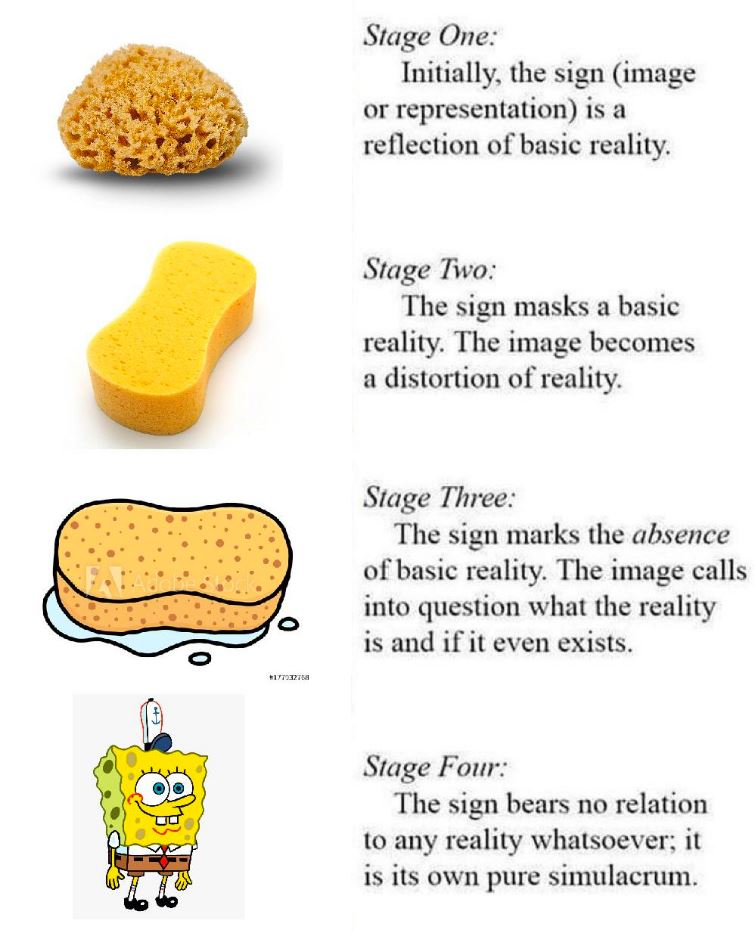
It is into this world that we, as the 21st century political subjects, find ourselves reterritorialized once again. As Jonathan Haidt observed in the Atlantic, the past decade plus of politics has been uniquely awful. In it, he references the Babel myth, which was the touchstone of my never-to-be-written PhD thesis that we are undergoing a Babel event currently.
Tying together the myriad threads of the past three posts (and my philosophical work in general), let me offer to you my thesis: humans are narrative creatures. Across all cultures that have ever been, back to the earliest pictographic representations we scribbled on cave walls, humans tell each other stories. We present — and learn — information in narrative form because that is the way that we impose sense upon the world around us. We are a thinking, perceiving subject continually telling itself a story about ourselves.
As we emerged from the tribal bodies into the lord/bondsman dialectic, our stories stopped being ultra-individualized and became society-generating and -spanning mythos. Our stories told us not only who we were, and what we had done, but what we valued, what we stood for, and where we were supposed to be going. We developed grand metanarratives not only to give our lives value and direction, but to provide the very basis of meaning that caused us to try to survive day to day.
And then, very suddenly, with the dropping of the atomic bomb of Hiroshima and Nagasaki, we wrote the end of our tale. We saw that progress was not linear, not always a net positive, and that we had not properly dealt with Being-toward-death, that the death drive was alive and well. Deleuze and Guattari, our subjects under consideration said it best:

That is why the fundamental problem of political philosophy is still precisely the one that Spinoza saw so clearly, and that Wilhelm Reich rediscovered: ‘Why do men fight for their servitude as stubbornly as though it were their salvation?’…Reich is at his profoundest as a thinker when he refuses to accept ignorance or illusion on the part of the masses as an explanation of fascism, and demands an explanation that will take their desires into account, an explanation formulated in terms of desire: no, the masses were not innocent dupes; at a certain point, under a certain set of conditions, they wanted fascism, and it is this perversion of the desire of the masses that needs to be accounted for.
— from Anti-Oedipus
To that end, we began to diverge, along fault lines laid down by the earliest thinkers in our philosophy: Plato and Aristotle. As Deleuze himself observed, the history of Western philosophy has been a history of binary oppositions. I hypothesize that the reason for this is that such a binary opposition is present in the Being-toward-death: death and life. Zero and one. Something and nothing. Being and Not-Being. Subject and object. Us and them. Because this is so fundamental to the experience of being human, we mistook this dualistic view for a metaphysical truth, and this allowed the emergence of two overarching metanarratives, a false binary between two all-consuming structures. In one structure, we find philosophies and thoughts often grouped together, such as (say) conservative politics with religious thought, non-monetarist economics, racial prejudice, a positive view of colonization, etc. and so on, and largely their binary opposites in the liberal body politic.
“The new materialism takes from Nietzsche the notion that each body or product is a synthesis of forces, a sign or symptom of a mode of existence. Desire is never something that is missing, forbidden, or signified: desire is a power of synthesis that constructs an assemblage in order to increase its power of acting.” — Phillip Goodchild, Nottingham University
I do not think this amalgamations are chance or even historically determined. I think they are absolutely socio-historico-philosophical-ecological-cultural-psychological-and-so-on determined products. I think they arise from the two basic stories we tell each other: the story of lords, and the story of bondsmen. But more than that, each person who tells these stories to make sense of the world takes with her an entire history catalogue’s worth of signs and images, imports of meaning and value. And even though two speakers might be conversing in the same language, from the same culture, using the same dialect, their speech is now mutually unintelligible because they have succumbed to a Babel Event: our worldviews, Husserlian Lebenswelt, Kantian weltanschauung, whatever you want to call it, are fundamentally incompatible because of the importation of the false binary in outlook.
The two main conglomerates, call them left and right for simplicity, are aggregates of entire cultural superstructures that have become mutually incompatible and irreconcilable. Those who adopt one view or the other become unable to function in a society built mainly by their opposite numbers. In Deleuzian terms, the reterritorialization of the late 20th and early 21st centuries has created entirely different systems of machines. Our libidinal desires no longer arise from the same source within our psyche, and as a result, we literally cannot understand one another any more.

That is, unless we can escape the binary metanarrative. Unless we can achieve the schizophrenic and embrace multiplicity. Unless we can learn to speak the uttered phrase and understand the un-uttered and in-utteral semiotic and semantic commitments along with what we are saying.
[T]he goal of schizoanalysis: to analyze the specific nature of the libidinal investments in the economic and political spheres, and thereby show how, in the subject who desires, desire can be made to desire its own repression—whence the role of the death instinct in the circuit connecting desire to the social sphere. [...] Schizoanalysis is at once a transcendental and a materialist analysis.
For years, I was stuck with the end result of my thesis being exactly what Haidt complained about in 2022: we have crossed the Babel Horizon. No longer do Americans speak the same language, refer to the same touchstones, or share the same reality-making narrative. We are narratives at cross purposes. I thought, pessimistically, that when the two Narratives met, one must either triumph over the other or the must cancel each other out in nuclear apocalypse.
However, maybe I threw in the towel too soon. At the very least, law school interrupted my studies and I was not able to devote a decade of my life to wrestling solely with this philosophical problem, though it has been ever-present in my life. But I think I may see a solution now on the horizon, in adopting a schizoanalytic perspective.
Deleuze and Guattari themselves summarized schizoanalytic practice in the fourth chapter of Anti-Oedipus, “Introduction to Schizoanalysis,” as prompting the questions
"What are your desiring-machines, what do you put into these machines, what is the output, how does it work, what are your nonhuman sexes?"
In this sense, they developed four theses of schizoanalysis:
- Every unconscious libidinal investment is social and bears upon a socio-historical field.
- Unconscious libidinal investments of group or desire are distinct from preconscious investments of class or interest.
- Non-familial libidinal investments of the social field are primary in relation to familial investments.
- Social libidinal investments are distinguished according to two poles: a paranoiac reactionary pole, and a schizoid revolutionary pole.
Let’s break these down.
The first thesis is that all our psychic investment is social, or unfolds within a social space. These “investments,” or that which we give attention, desire, and thought, belong to us by group or individual desire primary to preconscious identifications such as class or self-interest. Schizoanalysis posits that these emotional investments are primary, both de jure and de facto, and that they are distinguished according to a bipolar scheme: a paranoid (in psychoanalytic terms) reactionary pole, and a schizoid revolutionary pole.
“It is very important for it that the limit of this production be displaced, and that it pass to the interior of the socius, as a limit between two molar aggregates, the social aggregate of departure and the familial subaggregate of arrival that supposedly corresponds to it, in such a way that desire is caught in the trap of a familial psychic repression that comes to double the weight of social repression. The paranoiac applies his delirium to the family—and to his own family—but it is first of all a delirium of races, ranks, classes, and universal history. In short, Oedipus implies within the unconscious itself an entire reactionary and paranoiac investment of the social field that acts as an oedipalizing factor, and that can fuel as well as counteract the preconscious investments. From the standpoint of schizoanalysis, the analysis of Oedipus therefore consists in tracing back from the son’s confused feelings to the delirious ideas or the lines of investment of the parents, of their internalized representatives and their substitutes: not in order to attain the whole of a family, which is never more than a locus of application and reproduction, but in order to attain the social and political units of libidinal investment.” — Anti-Oedipus
In our current politics, the old dichotomy of reactionary and revolutionary poles is no longer viable to the extent that both our extant Left and Right superstructures contain moneyed/powerful groups that are willing to make these investments. Whether you’re a Fox viewer or an MSNBC viewer, you’re enslaved by molar aggregates under a technocratic paradigm of mass media and entertainment that seeks to dominate your narrative reality.
The secret of escaping the narrative conflict is the realization that the bipolar situation does not possess an underlying unity but is instead part of a hylë-istic whole, two modes of the same Spinozist substance. The pull between reaction and revolution is meant to give basis for the two narratives to exist, to provide for their conflict in the first place. But you can reject the conflicting narrative metanarrative if you realize that the conflict is artificial, that it arises from the old metaphysics of identity and binary oppositions. Adopting the new multiplicitious metaphysics allows you to take on a new series of libidinal investments, this time not in terms of narrative-driven conflict but the underlying desire for connection itself.
All humans desire this connection, to be heard and understood. Narrative is our best attempt at this, but certainly not the only one. As we have seen with experimentations with the narrative form (think Calvino, or Innis, or any number of experimental, post-modern novels) we can reject the old ideas of form and still be able to communicate because the basis of all communication is the desire for connection.
A new left politics based on the desire for connection would be one that could invite, and play with, the traditional concepts like class struggle or identity politics, but would never be bound by them. It would reject all attempts at structure and binding in favor of rhizomatic growth, with a focus on creativity and experimentation in art and science. In other words, maximal individual freedom, ecstatic consumption and experience of the beauty and wonder of art, knowledge, philosophy, and so forth, based upon the notion that all humans desire connection, and the creation of political structures under which this kind of free, creative experimentation can occur, which is necessarily a rejection of totalitarian or lack-based, paranoiac structures or rigid, revolutionary structures where all production must be geared toward the revolutionary pole.
In pragmatic terms, this looks like basic organization at a local level with things like mutual aid, community gardening, libertarian municipalism, and so forth. Resistance to overarching paranoic/fascistic tendency proceeds not by means of revolution (or at least, not solely by revolution) but by refusal to make the sorts of libidinal investment that the reactionary narrative demands.